
ADAS Calibration
ADAS Calibration Morayfield
Modern cars steer, brake and warn using a camera mounted to the windscreen. After a replacement those driver-assist systems must be recalibrated to the manufacturer's exact specification — we calibrate so your lane-keep and auto-braking work the way they should.
Interactive · How it works
See how an ADAS calibration is done
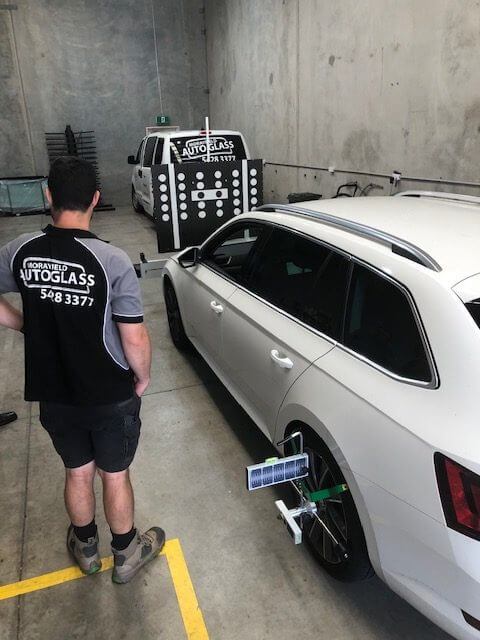
A real calibration from our workshop. Tap a number on the photo — or step through below — to see what each part does.
The windscreen camera
Behind your rear-view mirror sits a forward-facing camera that runs lane-keep assist, autonomous emergency braking and adaptive cruise. The moment we replace the windscreen, that camera shifts — so it has to be shown exactly where 'straight ahead' is all over again.
The calibration target
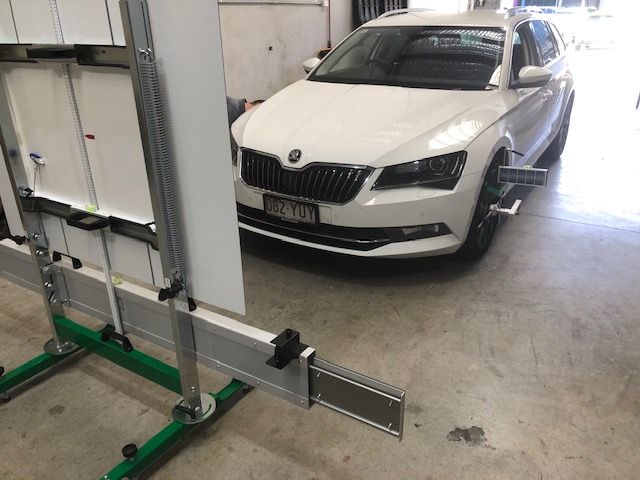
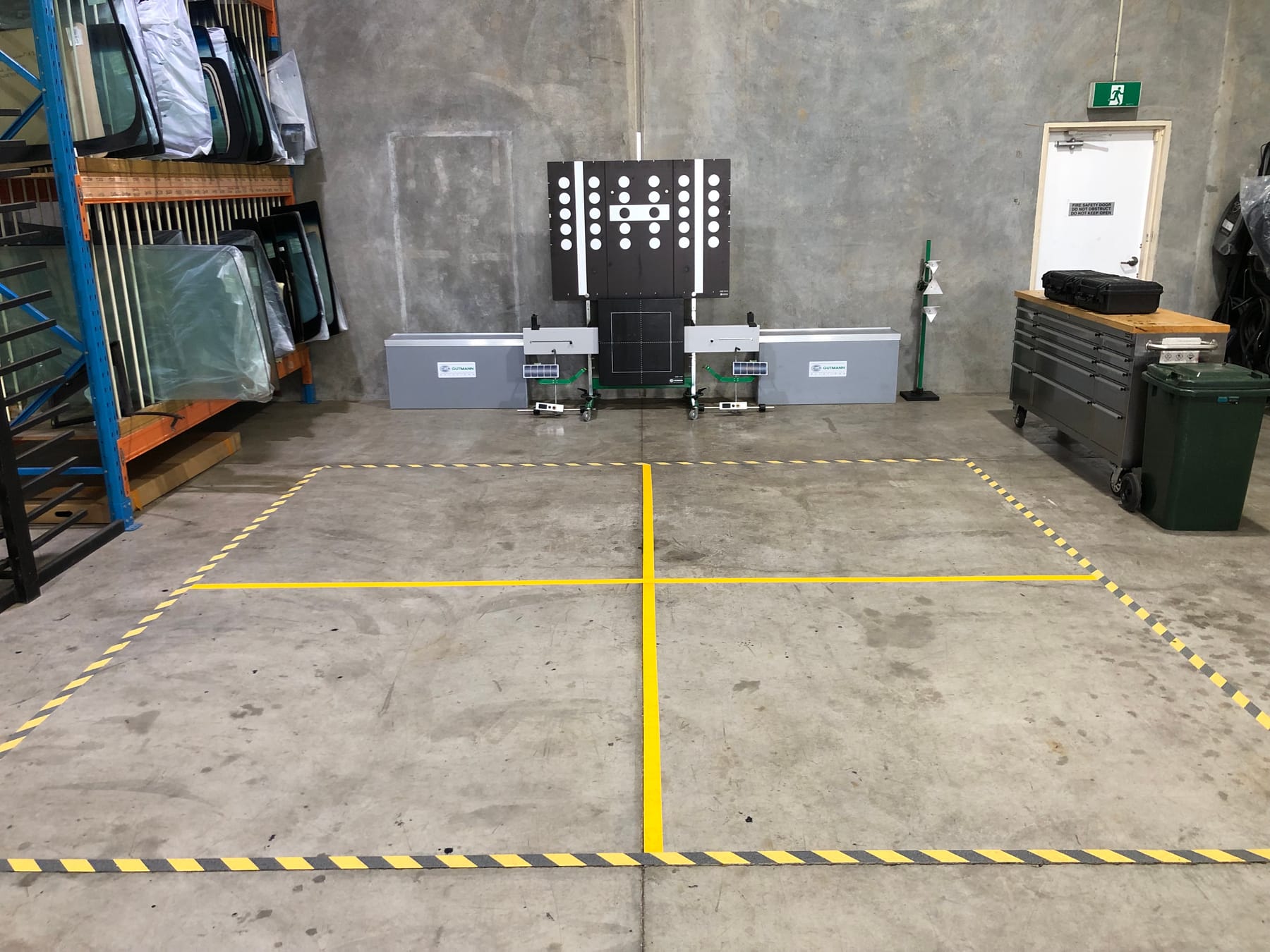
This patterned board is set at a precise distance, height and angle in front of the car — figures the manufacturer specifies for that exact model. The camera reads the known pattern and the diagnostic tool corrects its aim back to factory spec. That's a static calibration.
Wheels & thrust line
Calibration is referenced off how the car actually tracks down the road, not just the shape of the body. We clamp the wheels to find the thrust line, then square the targets to that — get this wrong and every reading after it is wrong too.
Technician & scan tool
Our technician runs the manufacturer's procedure on a diagnostic scan tool, completes any dynamic road-drive the car also needs, and signs off with a pass report confirming lane-keep, braking and cruise all read true before you drive away.
Is this your car?
Built in the last decade or so?
If your car has any of these, the camera that runs them almost certainly lives on the windscreen — and it must be recalibrated whenever the glass comes out.
- Lane-keep assist / lane-departure warning
- Autonomous emergency braking (AEB)
- Adaptive cruise control
- Traffic-sign recognition
- Forward-collision warning
- A camera visible behind the rear-view mirror
Not sure? Send your rego and we'll tell you exactly what your car needs.
Done parked in the workshop, reading manufacturer target boards set at exact distances and heights. Precise, repeatable, weather-proof.
- In our Caboolture workshop
- Calibrated to printed targets
- Best for many European & Asian makes
Done on a road drive at set speeds while the system relearns the road from live markings and traffic. Some makes need this; a few need both.
- On a mapped calibration route
- Live road-marking relearn
- Often paired with a static pass
If your car was built in the last decade or so, there's a fair chance it's watching the road for you — lane-keep assist, autonomous emergency braking, adaptive cruise, sign recognition. The camera running all of it is mounted to the back of the windscreen, staring out through the glass.
Swap that windscreen and the camera shifts, even by a hair — and a hair is enough for the car to misread where the lane is or how close the car in front sits. Calibration realigns it to the manufacturer's exact figures so the systems read the road properly again. It isn't a nice-to-have; it's the step that makes the safety gear actually safe.
We do ADAS calibration Morayfield-side as part of the replacement, not as a job you have to chase across town. Depending on the make that's a static calibration against printed targets, a dynamic calibration on a road drive, or both — and you leave with a pass report confirming every system checks out. There's a real example from our workshop floor a little further down this page.
ADAS calibration Morayfield: has your car got it?
If it's roughly seven years old or newer and runs lane-keep, auto emergency braking, adaptive cruise or sign recognition, the forward camera almost certainly lives on the windscreen — and it has to be recalibrated whenever that glass comes out.
Parked, driven, or both
Some cars calibrate parked, reading printed targets set at exact distances. Others need a road drive at set speeds, and a few want both. We work out which your model calls for and do it properly rather than guessing.
Not a tacked-on extra
An out-of-line camera can read a lane or a following distance wrong, which means the car might brake late or steer where it shouldn't. That's why we finish the relevant replacements with a calibration and hand you the proof — it's safety, plain and simple.
Pricing
Calibration is quoted alongside your replacement and rolled into the one price — no separate trip and no surprise add-on.
(★) — Customer reviews
What Moreton Bay drivers say
Five-star rated by locals
Read all on Google- 01
“Needed an unusual windscreen sourced and Mark had it sorted within 24 hours. Couldn't fault the service.”
— Alan Ryan
- 02
“Booked in the morning and in just a few hours my car windscreen was repaired. Quick, friendly and professional.”
— Amy Jackson
- 03
“Their attention to detail was amazing — my car looks as good as new. Highly recommend the team.”
— Alf Langley
(FAQ) — Good to know
Questions, answered
Still not sure? Call us — we'll talk it through, no pressure.
01 Can you fix my glass at my home or office, or do I have to come to you?
Both. We're a mobile service across Morayfield, Caboolture and the wider Moreton Bay Region — our technicians come to your home, workplace or business fleet yard and carry the trade equipment to do a clean windscreen replacement or chip repair wherever your vehicle is safely parked. You're also welcome at our workshop at 9/30-36 Dickson Rd, Caboolture South.
02 How long does a windscreen replacement take, and when can I drive?
A standard mobile windscreen replacement usually takes 45 to 60 minutes to fit. We use premium, fast-curing structural adhesives with a certified Safe Drive-Away Time of around 30 to 60 minutes after the glass is bonded. Your technician confirms the exact safe drive time on-site before handing back your keys, so you're always compliant with Australian safety standards.
03 Can a small stone chip be repaired, or does the whole windscreen need replacing?
If the chip or star fracture is smaller than a $2 coin and sits at least 5cm from the outer edge of the glass — and isn't in the driver's direct line of sight — it can generally be repaired without removing the windscreen. Our high-vacuum resin injection restores the strength of the glass in under 30 minutes, saving you time and money before the damage spreads in the heat.
04 Will a cracked windscreen pass a Queensland roadworthy inspection?
Generally, any crack that extends into the driver's direct line of sight, or any crack longer than 30mm anywhere on the glass, will fail a Queensland roadworthy (safety certificate) inspection and make the vehicle unroadworthy. Repairing chips early or replacing heavily damaged glass keeps your vehicle compliant and avoids costly fines.
Get sorted
Cracked it this morning?
You could be sorted by this arvo.
Get a free quote in under a minute, mobile across the Moreton Bay Region, and a lifetime workmanship guarantee on every job.